

Burnout: A Verbatim Play
Framework Theatre’s newest production focuses on career and social burnout affecting younger generations.

Following my reviews of the Scottish theatre I saw in Fall 2025, I’m returning to write up my reactions to shows that I’ve seen in 2026 a bit closer to the event. First up is Burnout: A Verbatim Play, produced by Framework Theatre at the Tron.
Burnout: A Verbatim Play
Written by Ellen Bradbury, Directed by Emma Ruse
Production Company: Framework Theatre
Venue: Tron Theatre
Date: 6 February 2026
Ticket Price: £19 (no fee)
Run Time: 60 minutes
Summary: 27 individuals. 1 shared story. Burnout is a feeling some of us know all too well, but how can it be confronted? And is it here for the long-run? Burnout: A Verbatim Play explores the psychological and physical impacts of Burnout in education, healthcare, activism, and more.
Since 2021, Ellen Bradbury has been interviewing 27 individuals about their experiences of being burnt out. Her findings? That these stories are both all too familiar and unspoken.
This is an original commission by Framework Theatre. Every word in the script is verbatim—real words from real people about their experiences. The team are delighted to finally debut this production alongside an incredible team of emerging and early-career theatremakers. (From printed program, pictured below.)
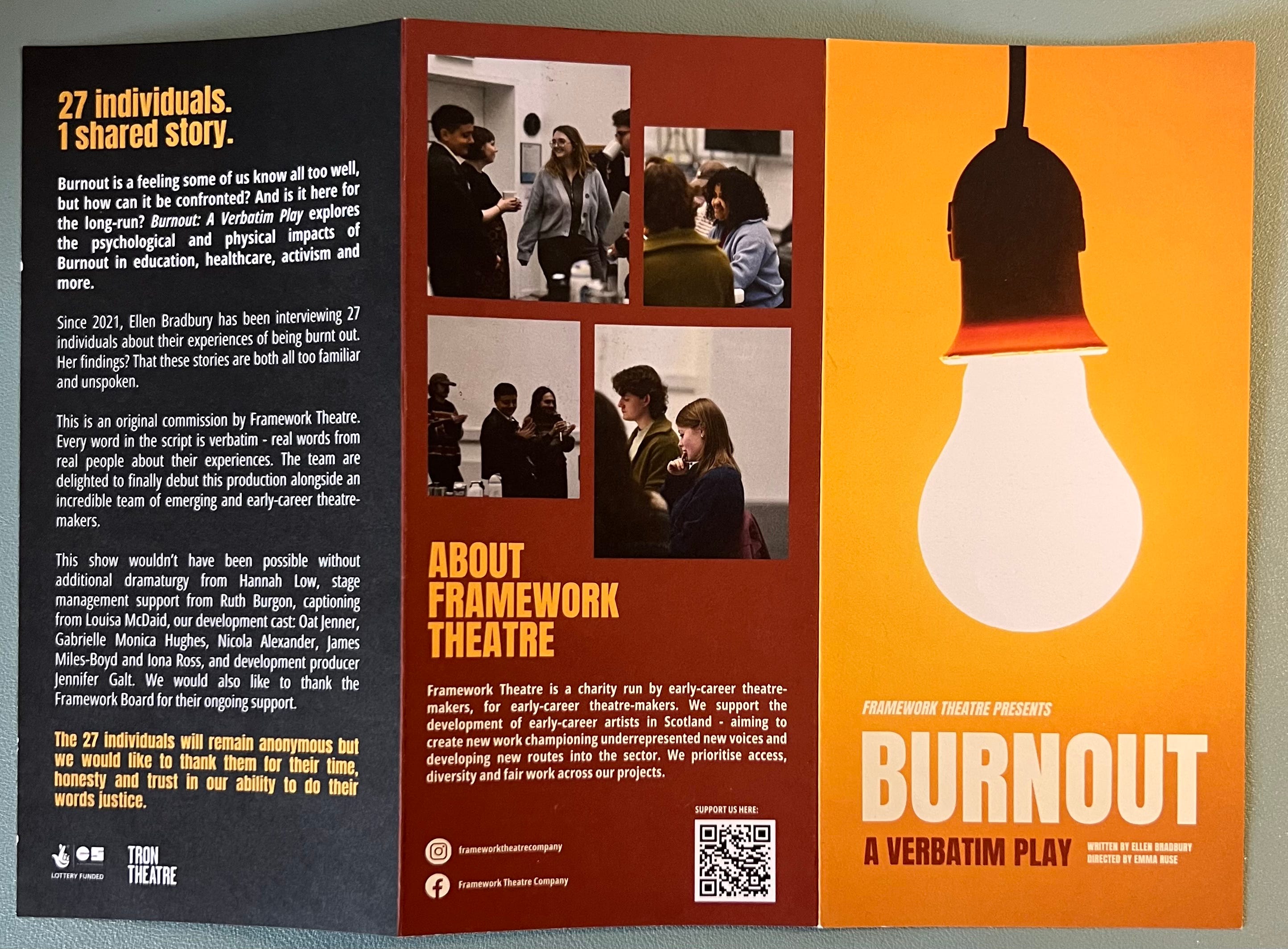
Thoughts: I was excited to return to the Tron to see Framework Theatre’s newest production, Burnout: A Verbatim Play. Framework just celebrated their fifth anniversary, having been formed by young graduates and committed to developing young artists in Scotland in 2020. Burnout featured four actors, a sparse (yet compelling) design, and closed captioning in a unique and comforting sur-title format. The production quality was well-suited to the Tron space and featured a series of intersecting monologues fused from twenty-seven anonymized submissions that described the impact of burnout and its burdens on young people who have recently graduated university. Their approach felt targeted to a younger crowd than the folks I attended with1, but seemed to align with Framework’s mission to support emerging and early-career theatre makers.
I appreciated the candor and attention to detail that playwright Ellen Bradbury took to form the composite “characters” portrayed by the performers. Having taken a similar journey of self-discovery after reading Emily & Amelia Nagoski’s Burnout: The Secret to Unlocking the Stress Cycle in the time around when Framework Theatre was formed, the sensations depicted from doing too much were all too familiar. Bradbury unified the amalgam of submitted stories into cohesive personas, and the direction felt spacious enough for the actors to infuse their portrayals of absolute overwhelm with authenticity.
The set was a simple cyc backdrop, uplit with magenta lights that veered into fire orange behind what started out as four side-by-side yellow chairs that eventually became a veritable sea. The metaphor was gentle, yet visceral and poetic. The play ended with a single blue chair that had been quietly inserted into the jumble of yellow chairs. As I saw it come onto the stage, I thought perhaps that the four characters would meet in a support group (and interact with each other), but the consensus of my showgoing mates was that the blue chair represented the hope for their futures. Perhaps I was looking for open questions or even more practical solutions (like the ones provided in the Nagoskis’ supplemental workbook) and that was beside the point. Instead, I was left feeling helpless as a person who has experienced and pushed through burnout, because I wanted to learn more about the conversation. Regardless, the audience was warm and I commend Framework Theatre for producing a well-attended and visually beautiful show.2
I was intrigued by the choice to include “a verbatim play” in the public title of the production. Using the word verbatim is an accurate choice for a play that incorporates “unedited” text3 that’s typically sourced from non-actors, but I wonder how familiar people outside of the theatre world are with this terminology. For those who may have come to this play based solely on the subject—rather than familiarity with Framework Theatre’s mission—or didn’t know how to identify their overwhelming stress after having recently graduated university, would they know that this production would convey the message that they’re not alone?
After accurately ascribing the plague of burnout to the pressures of a capitalist system in an interweaving fugue and acknowledging that the solution is more community, the message of the play reframed the onus of individual responsibility to ask us to be more gentle with each other. That is a valuable message and one that goes beyond hashtag self care, but perhaps if there had been a wider range of voices incorporated4, the play would have felt more universally encompassing to convey how burnout affects us all.5
As it stands, the production sits closer to the center of the spectrum of socio-political theatre in that it doesn’t prescribe revolutionary action, but it does give young people (rightly so) assurance that they are capable of taking care of themselves after the trauma of burnout. Burnout shared “familiar and unspoken” stories from people who have been isolated in their trauma. Framework Theatre’s production portrayed these “real words from real experiences”, but who was meant to hear them?
📸 Image credit note: social preview image composited from program photo and tron.co.uk.
All three of us are Americans returning to education after working in unrelated sectors for several years.
I realized too late that I didn’t collect any details about the sound design, but I do remember that it was also excellent. The costuming was simple and unified.
A definition of verbatim theatre from The Routledge Dictionary of Performance and Contemporary Theatre by Patrice Pavis:
It uses the stories and words of real people, quoting them or putting them in the mouths of actors to delineate a real historical situation. However, the point is not to reconstruct this situation in the way a historical play would do, but to use real materials, ‘diverting’ them to one’s own ends in an ironic or dramatized way, to rebuild a dramatic and political universe through authentic quotations.
The scripted text in a verbatim theatre production has been reframed into a new context, which in its own way is a form of editing. It is the artist’s ethical responsibility to be transparent about how the speaker’s words will be used and conveyed, and some artists also intentionally convey the original speaker’s mannerisms in the acting, in addition to words they speak.
Maybe there were a wider range of demographics available in the submissions, but they were subsumed by the young bodies and voices who portrayed them.
I think I resonated more strongly with Antje Schupp’s You Live You Learn, which was a short interactive and multidisciplinary monologue about how to move through the damaging after-effects of burnout.